How to tell if a supplement has real doses
Short answer. Read three things in this order: whether each compound has its own amount in milligrams, whether that amount is close to what published research used, and how many capsules a daily serving actually is. The third one catches most of the problem, because studied doses take physical room and a two-capsule serving cannot hold seven of them.
Disclosure is mostly solved. Dosing is not.
A few years ago the main complaint in this category was the proprietary blend: ingredients grouped under one name with a single combined weight, so you could see what was in the product but never how much. That practice still exists, mostly at the cheaper end and in one or two large legacy products.
But it is no longer the norm. Plenty of serious brands now print a full panel with a milligram figure next to every compound. If you are comparing carefully made products, you will usually find the doses disclosed on both. So disclosure alone stopped being a way to tell them apart, and a brand claiming transparency as its main advantage is claiming something most of its competitors also do.
The question that still separates products is different, and it is less comfortable to talk about.
The dose has to fit somewhere
Compounds in this category have amounts that published research actually used, and those amounts are not small. L-Theanine is studied around 200 mg. Rhodiola rosea extract around 250 mg standardized. NAC around 600 mg. Taurine in the hundreds of milligrams. Omega-3 is judged by its EPA and DHA content rather than the weight of the oil.
Add a few of those together and you are past a gram of powder before counting the capsule itself. That is the constraint nobody advertises: a capsule holds a limited volume, so the number of capsules in a daily serving sets a hard ceiling on how much total compound can be in there.
This is why a long ingredient list and a small serving size are in tension. A product listing fifteen or twenty compounds in two capsules is not hiding the doses. It is printing them, and they are small, and most readers scan the names rather than adding up the milligrams.
The one-minute check
Look at the panel and ask four questions.
One. Does every compound have its own amount, or is there a combined blend weight? A blend still means you cannot check anything.
Two. Is the amount near what research used for that compound, or is it a fraction of it? A name at 10 mg when studies used 200 mg is a label decoration.
Three. How many capsules is one daily serving? Multiply the serving size by what a capsule can physically hold. If the arithmetic does not allow the listed doses, the doses are not there.
Four. Will the company show you third-party testing for the lot you received? This is the only item on the list you cannot verify yourself from the label, which is precisely why it matters.
How 30BASE handles it
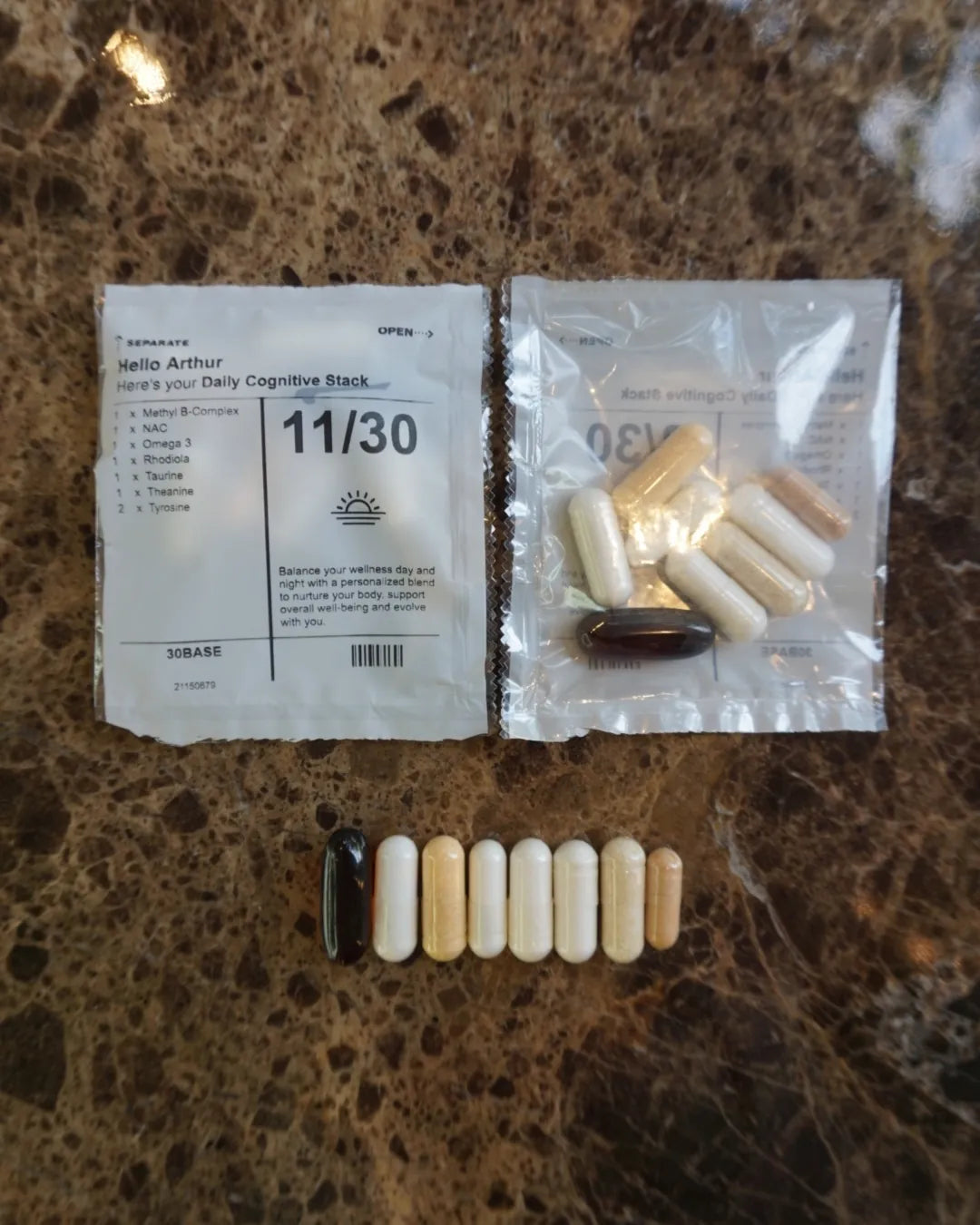
30BASE Daily Cognitive Stack is seven compounds, and a daily serving is eight capsules rather than two. That is not a selling point on its own, it is the consequence of keeping each compound at the amount published research used instead of trimming doses to fit a smaller serving. Seven compounds at studied amounts need that much room.
Every compound is named and printed in milligrams on the label, in bioactive forms, with no proprietary blends. The formulation is based on published clinical research, cited per compound. Every production lot is independently tested by an ISO/IEC 17025 accredited laboratory, with a Certificate of Analysis available on request, and every sachet is content-verified on the line rather than sampled by lot.
The eight capsules come pre-portioned in one sealed daily sachet, produced to order with your name and the day count printed on it, thirty sachets to a box. Full dose disclosure is the floor we start from. The part that is genuinely hard to reproduce is the verification and the finished, portioned product.
These statements have not been evaluated by the Food and Drug Administration. This product is not intended to diagnose, treat, cure, or prevent any disease.
Related reading
- What a cognitive supplement stack is
- Premade stack or build it yourself
- L-Tyrosine dosage
- L-Taurine 800 mg
- L-Theanine dosage
See the 30BASE Daily Cognitive Stack, seven compounds at studied doses in one pre-portioned daily sachet.
